
How to Treat Sensitive Teeth: Causes, Relief and What Actually Works

How to Treat Sensitive Teeth: Causes, Relief and What Actually Works

That sharp, sudden zing when you sip something cold, breathe in winter air, or bite into ice cream is one of the most common dental complaints there is. The good news: tooth sensitivity is usually manageable once you understand what is causing it.

What causes sensitive teeth?

Healthy enamel and gums protect the softer dentin layer underneath your teeth. Dentin is full of microscopic channels (tubules) that lead straight to the nerve. When dentin becomes exposed, hot, cold, sweet and acidic triggers can reach the nerve and cause pain. Common reasons dentin gets exposed include:

  • Enamel wear from acidic food and drink or over-aggressive brushing
  • Gum recession that exposes the root surface
  • After professional cleaning (scaling), whitening or other dental treatment
  • Cracked teeth, worn fillings, or grinding

How to relieve sensitivity at home

Most everyday sensitivity responds well to a consistent routine built around two proven approaches: calming the nerve and rebuilding the tooth surface.

1. Use a desensitising toothpaste with potassium nitrate

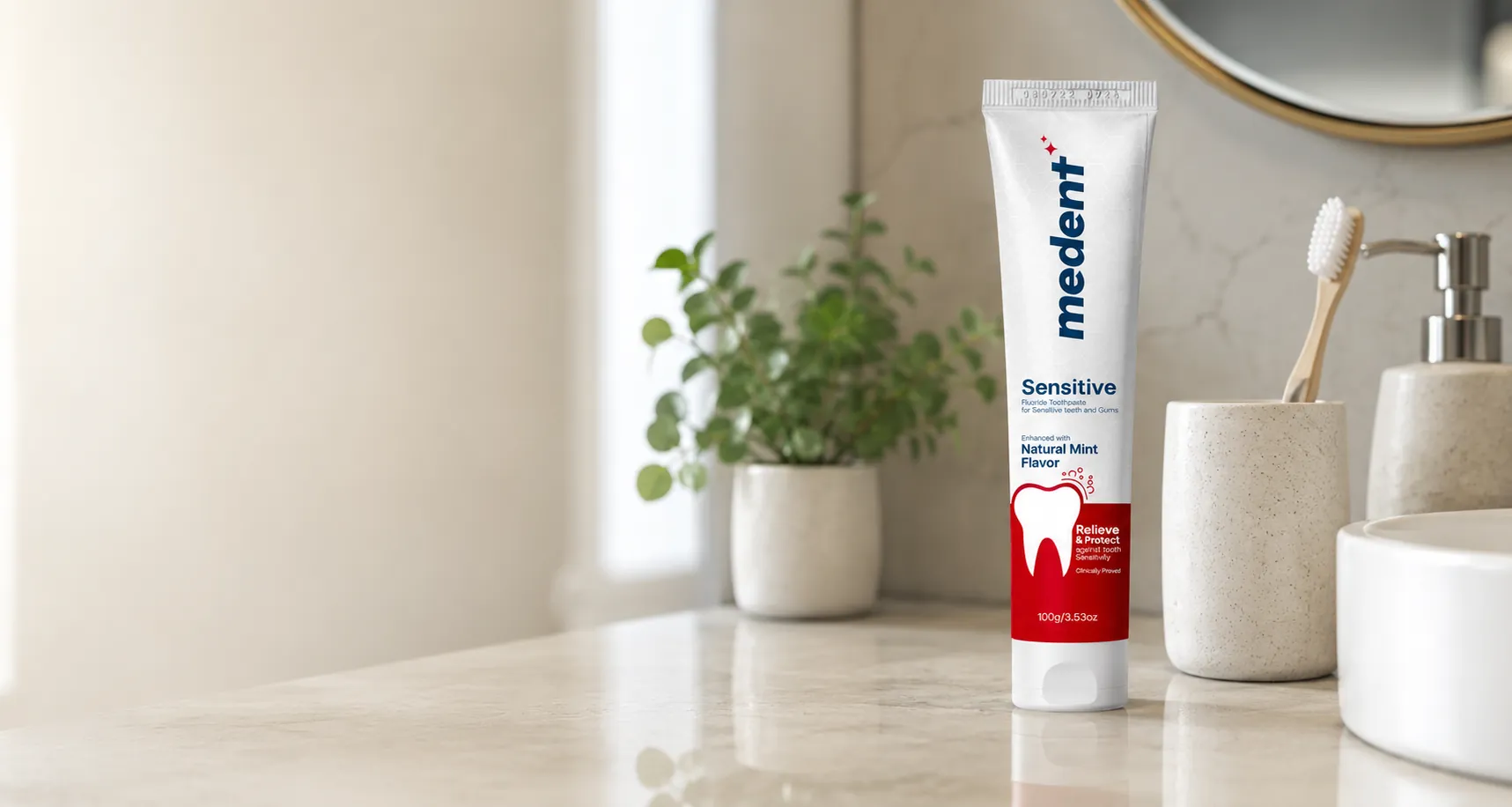
Potassium nitrate is the most-studied desensitising active. It works by reducing the excitability of the nerve inside the tooth, so pain signals fade over time. The key word is time — it is a cumulative effect that typically builds over about two to four weeks of twice-daily use, not an instant fix. Medent Sensitive is built around 5% potassium nitrate, the industry-standard concentration the clinical literature supports.

2. Rebuild the enamel surface

Sealing the exposed tubules physically is the other half of the equation. Nano Hydroxyapatite — the same mineral your enamel is naturally made of — can integrate into the tooth surface and help block the tubules while remineralising acid damage. Medent A.R.T. combines potassium nitrate for fast relief with nano hydroxyapatite for repair over time, which is a good option if you want a fluoride-free formula that treats sensitivity and enamel wear together.

3. Brush gently and rethink your habits

  • Use a soft-bristled brush and light pressure — scrubbing wears enamel faster.
  • Wait about 30 minutes after acidic food or drink before brushing.
  • Don't rinse immediately after brushing, so the actives stay on your teeth longer.
  • Use a pea-sized amount, twice a day, for two minutes.

Be patient and consistent. Desensitising toothpastes only work while you keep using them — the effect fades if you stop. Give any new routine a full 2–4 weeks before judging it.

When to see a dentist

Sensitivity that is sharp, localised to one tooth, or that persists despite four or more weeks of consistent care can point to something a toothpaste alone won't fix — a cavity, a cracked tooth, or gum disease. If that sounds like you, book a dental check-up.

From the Medent range

Formulated for sensitivity relief

This article is for general educational purposes only and is not a substitute for professional dental advice. If you have persistent symptoms, please consult a dentist.

Questions & Answers

More about Medent Sensitive

How does Medent Sensitive stop tooth sensitivity?
Potassium nitrate calms the nerve inside the tooth by reducing the excitability of pulpal nerve fibres, which lowers pain transmission when cold, hot, or sweet triggers hit. Sodium fluoride works separately to strengthen enamel and prevent decay.
Why does it take weeks instead of working right away?
Potassium nitrate needs to build up potassium ion concentration around the nerve with repeated use. It's a cumulative effect rather than a one-time coating.
Why 5% potassium nitrate specifically?
5% is the industry-standard, most-studied concentration for sensitivity relief. Higher isn't more effective — this is the level the clinical literature actually supports.
What does sodium fluoride actually do here?
It remineralizes weakened enamel and helps prevent the decay that can expose sensitive dentin in the first place. It works alongside potassium nitrate, not in competition with it.
Is xylitol safe to swallow trace amounts of?
Yes, for humans it's a safe sugar alcohol that doesn't feed decay-causing bacteria the way sugar does. It is toxic to dogs, so keep the tube out of pets' reach.
Why no artificial sweeteners?
Sweetened with xylitol instead — a natural sugar alcohol that doesn't contribute to plaque acid. No trade-off on taste, just a cleaner ingredient list.
Why does it matter that it's Triclosan-free?
Triclosan has fallen out of favor in oral care due to safety and environmental concerns, and most major brands have phased it out.
Is "no harsh abrasives" still effective for cleaning?
Yes — lower abrasivity is a deliberate choice for sensitive teeth, since harsh abrasives wear enamel and worsen sensitivity over time. It's a trade-off made for sensitivity care, not reduced cleaning power.
What does "Not Tested on Animals" and "No GMO" mean here?
Not tested on animals means no animal trials on the finished product or formulation. No GMO means none of the ingredients are derived from genetically modified sources — both are company commitments, not third-party certified claims, unless a certification mark is shown.
How is this different from a regular toothpaste?
Regular toothpaste is built for general cleaning and cosmetic benefits, often with higher abrasives. Medent Sensitive is built specifically around potassium nitrate and fluoride for nerve desensitisation and enamel protection.
Can I use it alongside a whitening toothpaste?
Yes, many people alternate — Sensitive daily, whitening occasionally — rather than mixing both in one session. Just avoid stacking two abrasive products on already-sensitive teeth.
Does it foam a lot / feel different from regular toothpaste?
Lower-abrasive, sensitivity-focused formulas often foam less than regular toothpaste — this is normal and not a sign it's working less effectively.
If it doesn't help after a month, what should I do?
See a dentist. Persistent sensitivity despite consistent use for 4+ weeks can point to a cause (like a cavity or cracked tooth) that toothpaste alone won't fix.
How long after opening is it good for / where should I store it?
You Should Consume the Toothpaste Within 3 Months after opening it , When Not In used Keep the Cap Tightly Closed and Toothpaste stored in Normal Room temperature.

Explore Medent Sensitive